Cellar dwellar (1987)
Cellar Dwellar (1987)
Initially what attracted me to Cellar Dweller (1988) was its name. A catchy rhyming reduplication. Silly yet charming. From the name and the plot summary, I had gathered that the film would be Ghoulies-esque, in a sense that I had expected a corny horror movie, that was more joy than scare. Ghoulies (1985) is not exactly a masterclass in film making, but its various mediocre elements come together to form something fun and memorable. However, the same could not be said about Cellar Dweller.
Cellar Dweller is about young comic artist, Whitney Taylor (Debrah Farentino), who joins an artist colony in efforts to continue the legacy of her idol, Colin Childress. The film begins with introducing the viewer with this supposed icon, who was the creator behind the horror comic: Cellar Dweller. In the opening scene of the film, Childress is seen illustrating his comic panels before the camera shifts focus on a specific drawing of a beast in the act of tormenting a fictional young woman. This is the principal monster of the whole film. Childress then pauses to read verses out of a book that clearly has malevolent origins. The very construction of the manuscript looks cartoonishly sinister. The verse that Colin reads essentially warns the illustrator not to draw out the beast or else it and the whole panel will be brought to life. Of course, this warning was very carelessly disregarded. The scene he had been sketching came to life, and the beast killed him. Shocking!
Years later, Whitney Taylor arrives to the house where the murder took place. It has now become a prestigious artist colony, where she has been accepted as a resident. The first person she meets is Mrs. Briggs, an established art historian and academic who runs the academy. Mrs. Briggs gives Whitney a tour of the residence and introduces her to the rest of the artists, while constantly throwing jabs at her, establishing early on that she does not respect Whitney’s “populist trifle”. From the onset, a secondary rivalry is established. This one between Whitney and her old classmate adversary, Amanda. The limited exposition tells us that they encountered each other in art school, where a negligible event occurred that resulted in them being rivals. Amanda is favored by Mrs. Briggs and even conspires with her in order to get Whitney kicked out of the colony, by fabricating allegations of plagiarism.
One night, when renovating her old hero’s workspace with newly acquainted fellow artist Phillip, Whitney stumbles across the same demonic book that brought about Childress’s misfortune. She begins to read some verses and tells Phillip that she believes “this” is what the Childress was working on before his untimely departure. In an effort to further emulate her hero, Whitney draws the same creature that had murdered Childress. The scene zooms out to expose Amanda spying. Amanda later breaks into Whitney’s work space, only to be caught soon after and sheepishly retreats, albeit with a sense of a machinating intent. Frustrated, Whitney sublimates her anger by drawing a comic in which the creature murders Amanda. Unsurprisingly, the scene comes to life.
Shortly after, the beast kills different members of the colony independently, and somehow each killing results in the mysterious genesis of a new comic strip. One by one, each artist is slain, until Whitney is the last one standing. While trying to fend him off, she ends up reviving the deceased Phillip by drawing him. This triggers this false realization that she has control of the beast through her illustrations. She revives the others in similar manner, but then proceeds to burn her drawing in order to kill the beast. Very quickly, the illusion of victory is shattered as Phillip and the rest burn alive and the beast live maniacally. The film ends with a close up shot of Whitney screaming and the beast declaring he will forever live on. This a very effective moment, for once the threat of the beast and his eternality feels concerning for both Whitney and the viewer. It was a shame that the only time I actively engaged with the film and Whitney’s emotion is on the last beat.
I have to take moment to say that this on camera relationship is the weirdest one I have ever seen. Philip is primed to be the love interest, but that never actually happens. He does things and says things that a love interest would typically do in any movie, while Whitney seems 50/50 with her feelings towards him. I’m not certain that Whitney is older than him by THAT much, throughout the movie she calls him a kid and acts quite sisterly towards him at times. Then there are other moments where they seem far too close that it just feels out of nowhere. He asks for a kiss on the lips after saving her, and she awkwardly gives him a hug. This kind of tone between them continues without Phillip ever seeming to get the hint, and it’s just painful to watch. Most of the time, any implications of romance feels forced and a little cringey, like the director was confused about what they wanted for these characters. As a classic, ‘will they, won’t they’ situation, the movie struggles to commit to one or the other. There’s not really much more to say here except it’s confusing.
One of my biggest gripes with this film is its underdeveloped commentary on “art”. The film always positions Whitney as better than the rest by showing us her product in comparison to everyone else. She is able to produce well illustrated flowing comic panels, while Philip creates bizarre finger paintings, Lisa performs odd dances that are devoid of meaning and Amanda uses her video skills for evil. It’s comes across as a parody. Even though Whitney has been positioned as the “better” artist, Mrs. Briggs, who is meant to represent the greater institutional landscape of the art world, dislikes her work and actively works towards Whitney’s ruin. The movie is just rehashing the old and tired opinion that contemporary is pointless and a skill-less pursuit. It is not particularly insightful and does not really add anything to the conversation. It has nothing to contribute in this matter. The construction of the comparison itself is also so weak, because Whitney is just a copy artist. She is simply trying to revive her favorite childhood comic book series, and has bragged that she can copy Chrildress’ style perfectly. The whole thing of it is just a little unavailing. There is no other way to put it.
I found writing this review quite difficult because there is not much to discuss here. The film is quite empty; it is the very definition of mediocrity. I have a hard time caring for these characters, they are all just impressions of humans. The construction of the story itself is quite weak as well. From the get-go, the idea of a comic artist going to colony to work on comics seems a little fantastical, especially when the institution in question has only accepted contemporary artists. I am just not convinced.
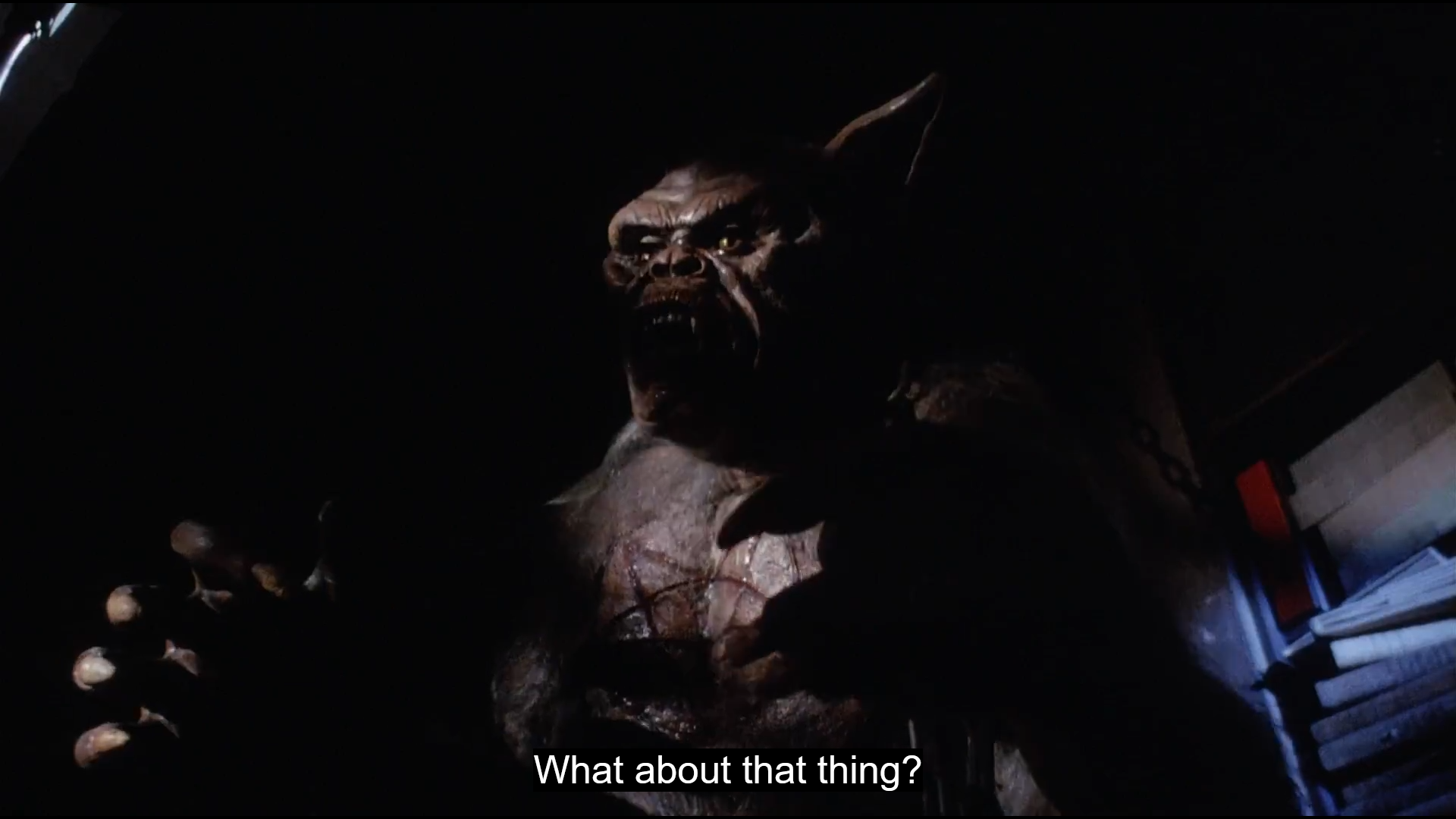
If you read this whole review and reached this point, then you would think I hated the film. I may have falsely given you the impression that this film has no merit, but it does a few things really well. Firstly, when a comic book scene starts to unfold into the real world, there are flowing shots between the comics and the real-life occurrence, and there’s this genuine sense of transference that’s very well done. I am sure the film has some message about how art imitates life and life imitates art, but like I said I don’t believe this film offers any substantial commentary. Secondly, the monster is great. I love a gooby monster. The creature looks like an overgrown gremlin with a pentacle etched onto his chest. He tends to manifest from shadowy corners when summoned, so in that regard, I find him to be very cat-like.
If Cellar Dweller interests you, then go ahead and give it watch. Otherwise, I would just recommend Ghoulies instead.
Not Recommended.